Retirement Readiness: Am I Ready to Retire When My Salary Stops?
One day, your salary may stop. Your expenses won't.
Inflation won't. Healthcare won't. And life may not stop at 80. You may have many years to live after your working years end. And someone you love may need your corpus after you're gone.
So the real question isn't only, “How much money do I need to retire?” It is, “How ready is my money for the years when I stop earning?”
If you have ever asked, “Am I ready to retire?”, this is where to begin.
Takes about two minutes. Nothing is saved unless you download your report or message us.
Three Honest Questions: Ready to Retire?
- Can you say what a month of your life may cost at 60, not today?
- Is part of your money invested specifically for retirement, and does it rise as your income does?
- If you stopped earning, could your savings last 25 years or more, and would your partner still be secure?
If any answer is “not sure”, you are in good company. That is where most people begin. Choose your decade below.
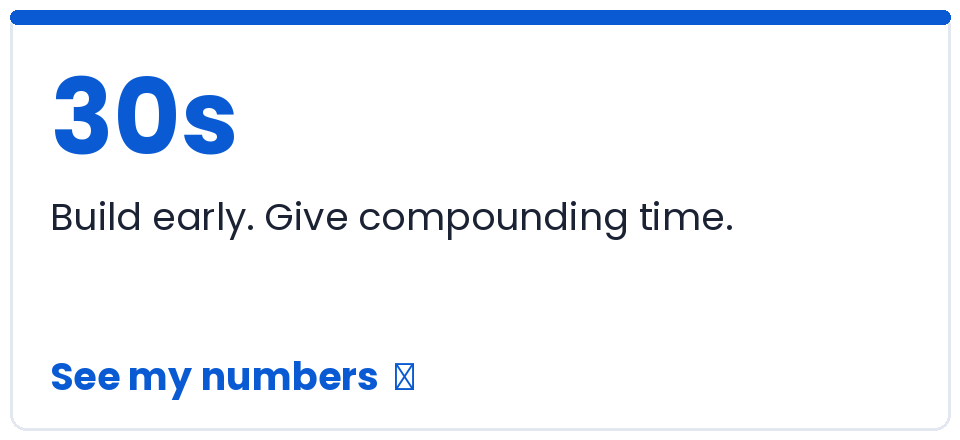
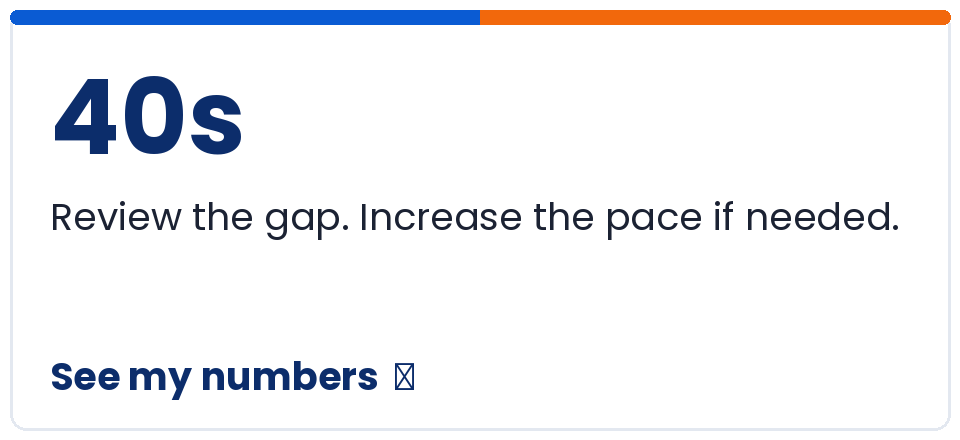
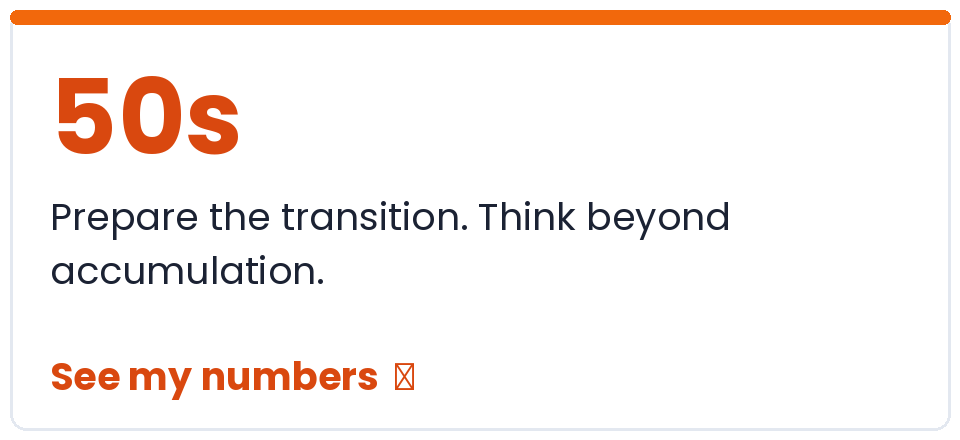
The Lazy Years: Life After the Salary Stops
Lazy doesn't mean doing nothing. It means waking up without your income depending on what you do that day.
No commute. No monthly salary credit. No boss waiting for Monday morning. But the electricity bill still comes. Groceries still need to be bought. Healthcare may become more important. And you may finally have the time to do the things you kept postponing : travel, family, hobbies, giving back, or simply sitting in the sun with nowhere else to be.
These are your lazy years. The challenge is to make sure your money is ready for them.
And, then there's FIRE. FIRE stands for Financial Independence, Retire Early.
It isn't necessarily about quitting work at 40. It is about reaching a point where money gives you choices. You may continue working because you want to, not because you have to.
Inflation: What Will Your Lifestyle Cost Tomorrow?
₹1 lakh ten or twenty years from now may not buy what ₹1 lakh buys today. That's what inflation does. And when you're building a retirement corpus, the effect can become significant over a long period. The lifestyle you enjoy today may cost considerably more when you retire, and the effect of inflation continues even after you retire.
Some expenses may also become more important with age. Healthcare is one of them.
A retirement corpus that looks comfortable on today's numbers can tell a very different story when today's expenses are projected forward.
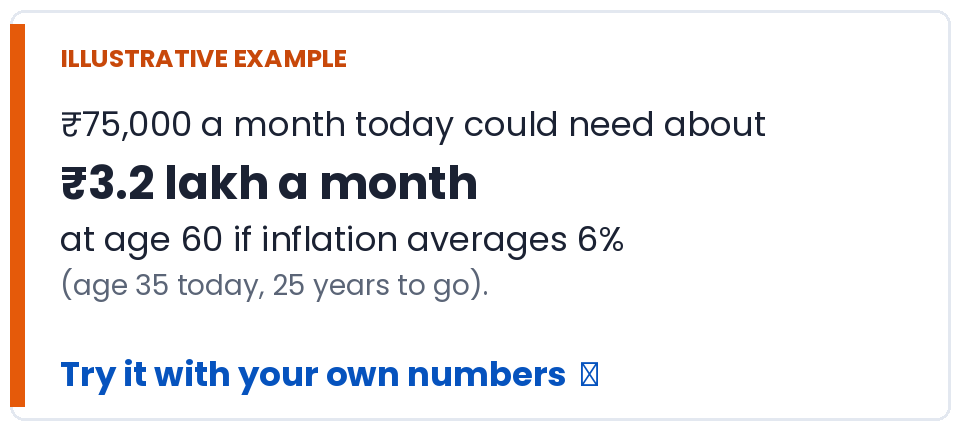
The Shrinking Rupee
Slide the years and watch what today’s money may buy later.
Illustrative. Actual inflation will differ.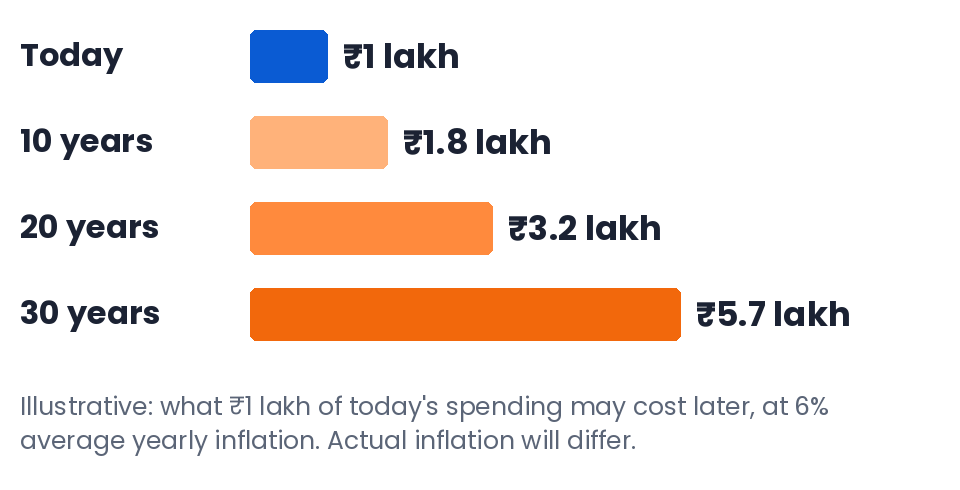
A Second Quiet Force: Your Own Lifestyle
Each pay rise tends to bring a better home, a bigger car, another holiday. That is human, and worth enjoying. But if your retirement savings stay where they were when you earned less, they are measured against a life you no longer live. Let your savings rise along with your lifestyle.
Healthcare Deserves Its Own Line
General expenses may rise steadily. Healthcare can become a different kind of weight altogether. Your health and your money are closely connected, so check that your cover keeps pace.
Time: The One Thing You Can’t Buy Later
Two people can aim for the same corpus at the same age and pay very different monthly amounts, simply because one started earlier. Here is the same goal, started at five different ages.
Plant Early
Same goal, same age: ₹5 crore at 60. Slide the age you start.
Illustrative: flat monthly SIP towards ₹5 crore at age 60, at 12% a year. Actual returns will vary.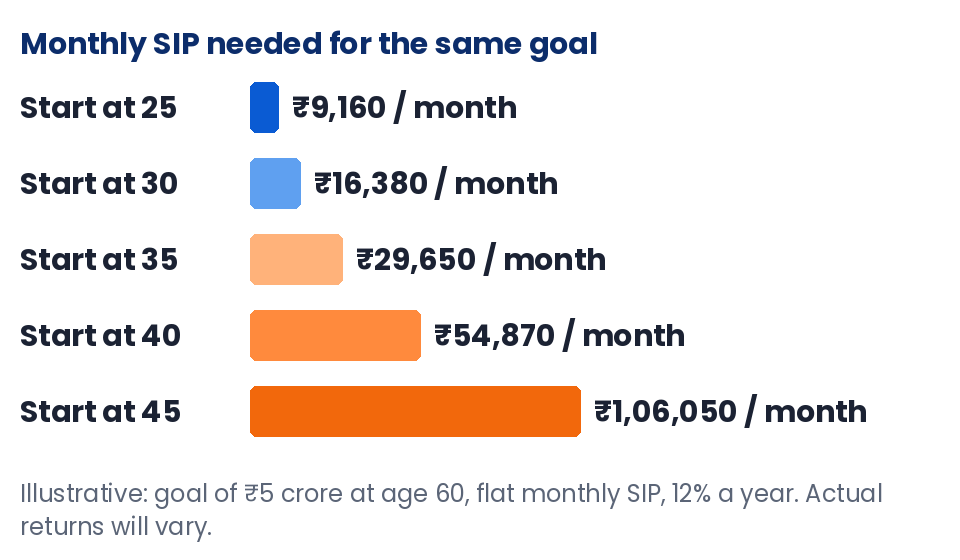
Each five-year delay roughly doubles the monthly amount needed. The earlier years do not just add to your corpus. They give every later rupee more time to grow.
A rough guide. If money grew at 12% a year, it could double about every six years (72 ÷ 12). It is a rule of thumb, not a promise. Real returns will vary, and some years will be negative.
If your income rises, your SIP can rise with it. A yearly step-up can lower the amount you need to start with. You can try both in the calculator.
“The best time to plant a tree was years ago. The next best time is this month.”
What If You Live Longer Than Your Money?
Longevity Risk And Your Retirement Corpus
Retirement isn't only about how much retirement corpus you need. It is also about making sure that corpus can support your lifestyle for as long as you live.
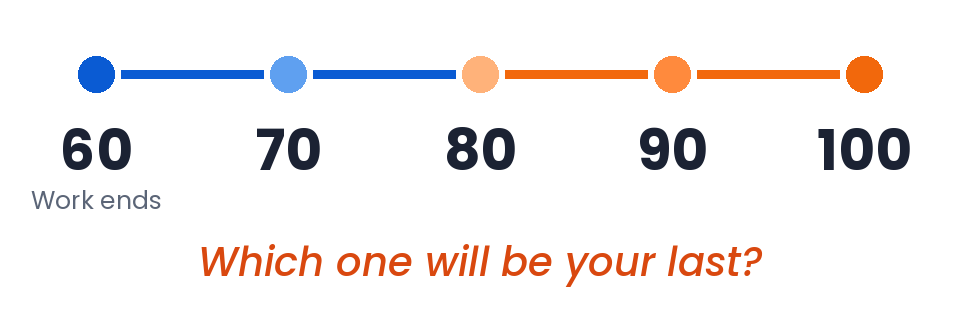
Your money shouldn’t run out just because you lived longer than expected. This is longevity risk : the risk of outliving your corpus.
That makes retirement different from most financial goals. A child’s education has a date. Retirement has a question mark at the other end. You have to prepare for a life whose length you do not know.
And What If You Go First?
Your Retirement Corpus May Have A Second Life
You've thought about your retirement. You've thought about your lifestyle. But have you thought about the person who may live after you?
Your corpus may have to support two lives at two different times, first yours, and then perhaps your partner's.
A simple stress test. What if your partner needs the corpus for another 10 years?
Not as a rule. As a question worth asking.
Because your retirement calculation shouldn't end with your own life expectancy. For many couples, one person’s retirement money eventually becomes the other’s financial security. That changes the story. It is a little like Baghban. You spent decades growing the garden. Who gets to sit in its shade?
Your retirement isn't complete until you have thought about survivor security too.
Survivor security means thinking about nominations, ownership and income continuity while you are still earning.
Lazy Money: When Your Money Has to Work for You
During your working years, you work for money. During retirement, your money has to work for you. That money needs to keep supporting your life without a monthly salary coming in. And it doesn't need to sprint. It needs to keep moving, steadily, patiently and for long enough.
Different Money, Different Jobs
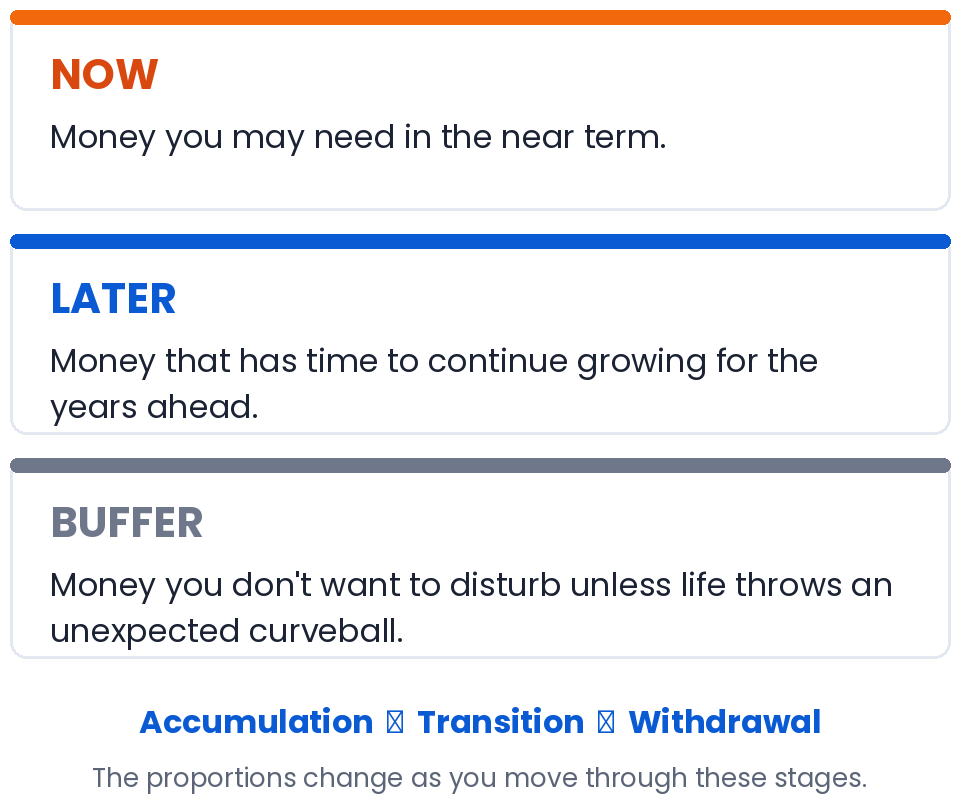
Think of your retirement money in three broad buckets.
NOW : Money you may need in the near term.
LATER : Money that has time to continue growing for the years ahead.
BUFFER : Money you don’t want to disturb unless life throws an unexpected curveball.
So, What Do You Do With All This?
Give Every Rupee a Job
There isn't one retirement product. There is a retirement job to be done. Different money may have different responsibilities.
The Job
Possible Avenues
Build the corpus
SIP or other systematic investing
Dedicated Retirement savings
NPS / other suitable avenues
Keep a sensible mix
Asset allocation
Create monthly cash flow
SWP / pension / annuity avenues
Handle surprises
Emergency reserve
Guard against big risks
health & life cover / asset protection
Protect the survivor
Enough corpus and continuity of income
Pass on what remains
Nomination, Will, succession
Review & adjust
As life, income and priorities change
These are avenues, not a shopping list. The right mix depends on your circumstances, time horizon, risk profile, cash-flow needs.
How Does The Money In Later Become Monthly Income?
One common method is SWP, a systematic withdrawal plan. It lets you draw a set amount from your investments at regular intervals, so that a corpus can behave a little like a salary. Whether it lasts depends on how much you draw, what your investments earn, and inflation.
What Fits?
पहले सवाल सही। फिर फैसला।
Right question first. Then the decision.
So don't begin with “Which product?”
Begin with : “What does this money need to do?”
Your First Eight Moves
Retirement readiness isn’t one big decision. It is a handful of small, repeatable ones.
- Picture the life.
Decide the life you want and the age you want it to start. - Put a number on it.
Use your own Blueprint, not a rule of thumb. - Start a SIP, then raise it.
Let it rise with every pay rise, and automate it so you never skip. - Build an emergency reserve.
Do this before you chase returns. - Check your cover.
Health and life cover, in your own name. - Set up your buckets.
As retirement nears, move money into Now, Later and Buffer. - Name your nominees and write your Will.
- Review once a year.
Life changes. Talk it through when it does.
Where Do You Stand? Am I Ready to Retire?
A Corpus Is Only the Beginning
People ask, “What is my retirement number?”
But retirement isn't one number. It has at least four dimensions.
CORPUS
How much money may I need?
CASH FLOW
How will I fund my monthly life?
LONGEVITY
For how many years might I need it?
SURVIVOR
What happens to the money if I go first?
The corpus matters. But so do the years it has to support, the income it needs to generate, the surprises it may have to absorb, and the person who may inherit the responsibility of living on it.
A number without a story can mislead. Your Blueprint gives you a useful starting point, and shows what the number needs to support.
Your Retirement Story Starts With a Reality Check
Do you know what your retirement lifestyle may cost, how large your retirement corpus may need to be, whether your current pace is enough, what inflation changes, and how long your money may need to last?
A retirement calculator can give you a useful starting point. But a number is only useful when you understand the story behind it.
Questions People Ask About Retirement
How much retirement corpus do I need?
How much retirement corpus do I need?
There is no single number for everyone. It depends on your lifestyle, retirement age, inflation, longevity and the security you want.
The useful question isn’t just “What is the number?” but “What does the number need to support?”
So the honest answer to “Am I ready to retire?” begins with your own numbers, not a rule of thumb.
How does inflation affect my retirement corpus?
How does inflation affect my retirement corpus?
Inflation reduces what money can buy. What you spend today may not maintain the same lifestyle after 10 or 20 years, so a corpus needs to be judged against future expenses, not today’s.
What is longevity risk, and how do I prepare for a long retirement?
What is longevity risk, and how do I prepare for a long retirement?
Longevity risk is the possibility of outliving your money. Since nobody knows how long retirement will last, it helps to assume you may live longer than expected, not to rely on one fixed age.
How can I create regular income from my corpus?
How can I create regular income from my corpus?
After retirement the goal shifts from building the corpus to using it responsibly. Income may come from pension, systematic withdrawals (SWP), annuity avenues and other sources together.
An SWP (Systematic Withdrawal Plan) allows an investor to withdraw a predetermined amount from an investment at regular intervals. It can be one mechanism for creating cash flow from a corpus, but the withdrawal rate, investment mix and longevity of the corpus need to be considered together.
Can SIP help build a retirement corpus?
Can SIP help build a retirement corpus?
SIP is one way to invest regularly towards a long-term goal. Starting earlier gives money more time to grow/compound, and raising the SIP each year can help. What suits you depends on your circumstances and risk profile.
Is NPS enough for retirement?
Is NPS enough for retirement?
NPS can be an important retirement savings avenue, but whether it is enough depends on your income needs, other savings and expected expenses. Its rules change from time to time, so check the current provisions.
Retirement security is usually a whole-picture question, not a one-product question.
What happens to my corpus if I die before my spouse?
What happens to my corpus if I die before my spouse?
Your corpus may become your spouse’s main financial security. That is why survivor needs, nominations, ownership and succession deserve attention while you are still earning.
Retirement Is Not The End Of The Story
You spent your working years building a life. Now build the money that can sustain it.
Retirement is the beginning of the years when your money takes over your role.
What fits your life? That is where the conversation should begin. Am I ready to retire? It is a question worth asking before the salary stops, not after.
Continue Your Journey
- Mutual Funds Sahi Hai: AMFI’s investor education site
- SEBI Investor website
- IRDAI policyholder education
Disclosure
Mutual fund distribution is provided by Arvind Arora (AMFI Registered Mutual Fund Distributor),
ARN-56507. Mutual fund investments are subject to market risks. Read all scheme-related documents carefully before investing. The information on this page is for general education. SIP, SWP, NPS, pension, annuity, insurance and succession avenues each have their own features, risks, taxation and eligibility. Illustrations use assumed returns and inflation, are not guaranteed, and are not a recommendation to buy, sell or hold any product. Decisions should reflect your own circumstances. (Privacy Policy)
Last reviewed: October 2026. Reviewed by Arvind Arora, ARN-56507 (About Us)